Gallery
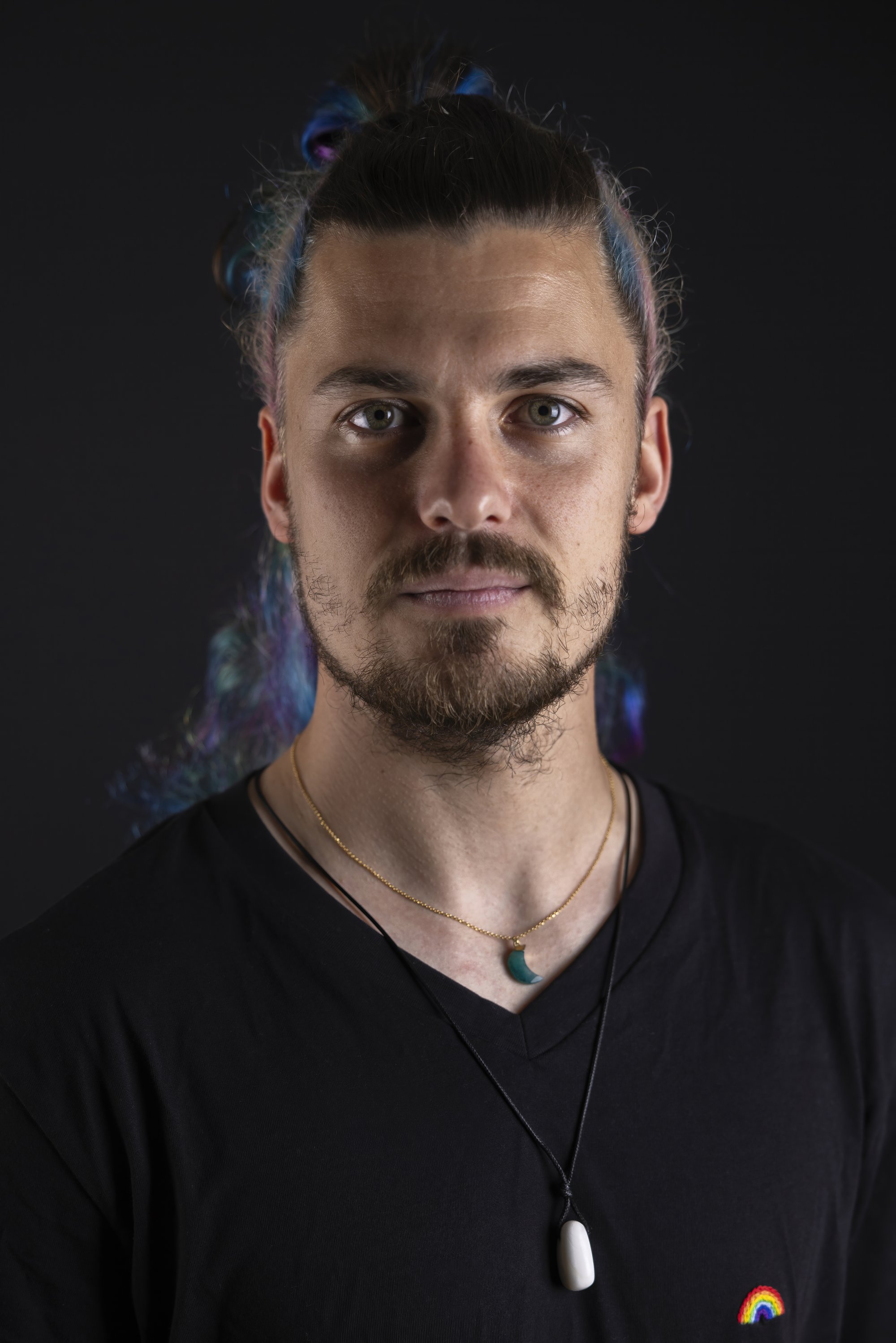
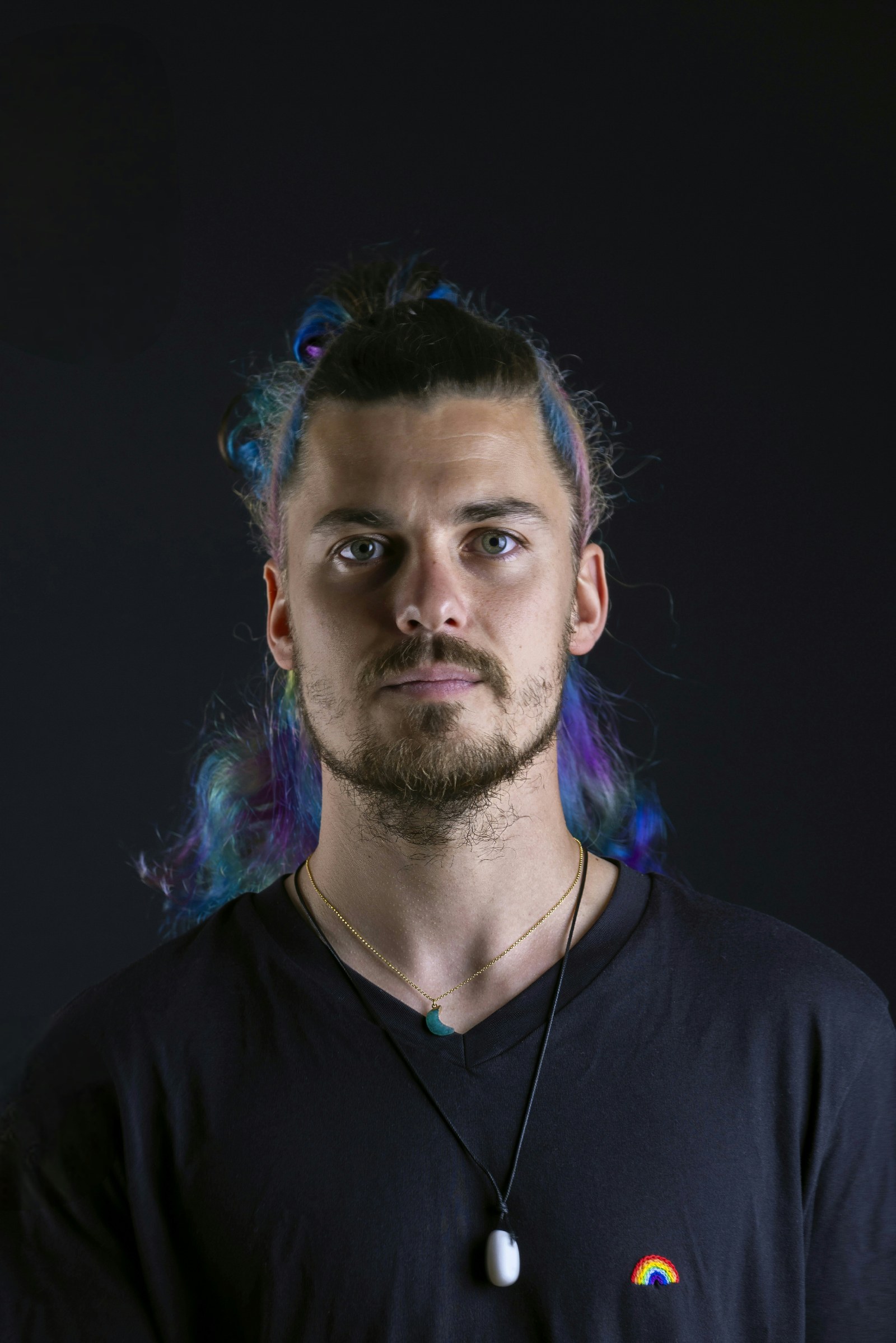
Imative_22112025_9400.jpg)
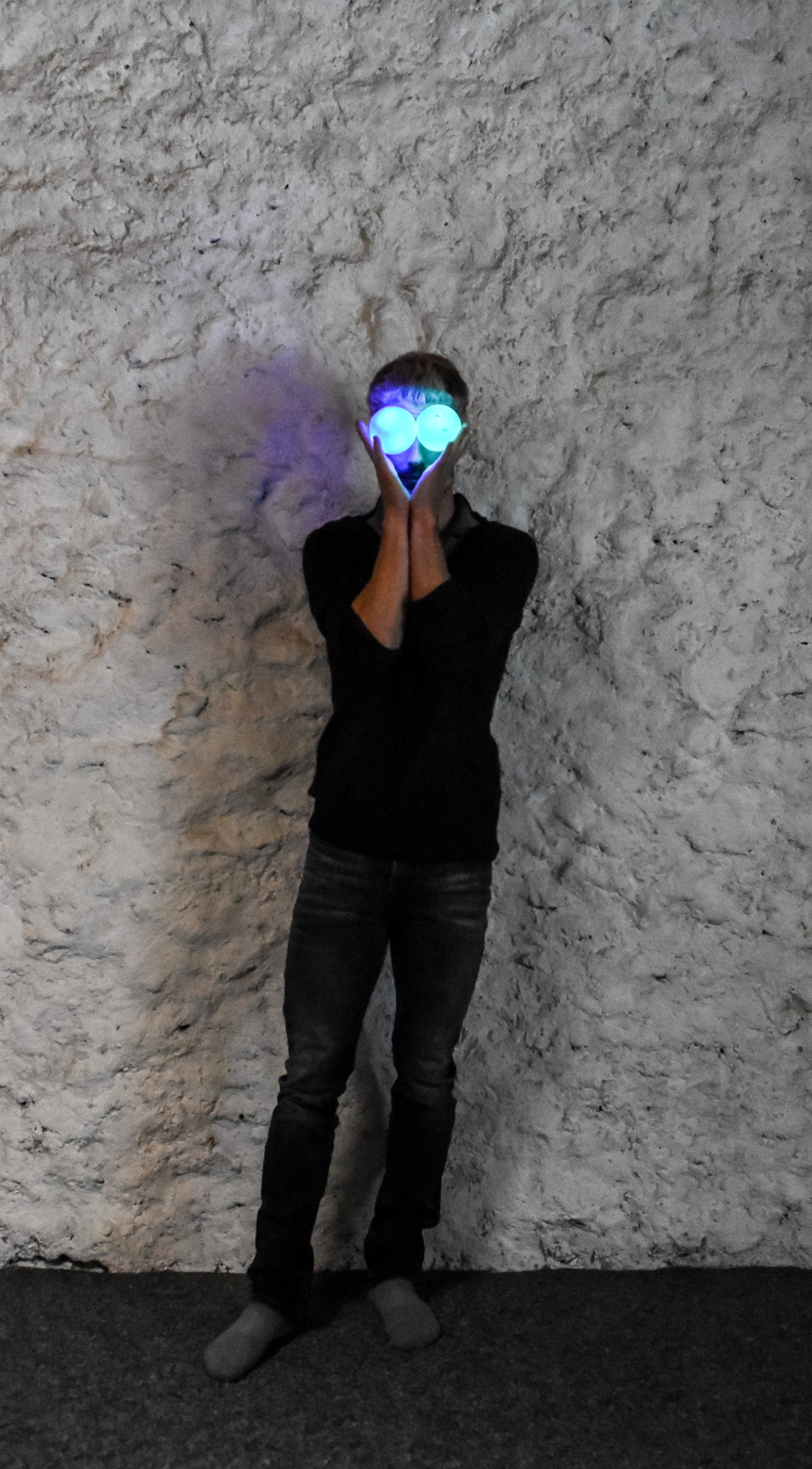
I was born in Accra, Ghana, and spent my first four years there — my mother is American, so I grew up between English and Swiss German. Then came Braunwald: a car-free village of about 300 people in the Swiss Alps. Two memories from there never left me: the crunch of fresh snow under my shoes on very cold winter mornings, and the forest next to my parents' house, where I climbed everything — testing whether a branch would hold my weight, feeling the balance all the way up to the crown. I taught myself devil stick with raw branches broken off those trees, before I knew the prop existed. I'd looked at a stick and thought: I could make this appear to float.
Then, at twelve, at a circus camp: a girl my age caught my eye, and I caught hers. We were both far too shy to actually talk. So we spent the entire camp — every free hour — in the big top, practicing juggling next to each other, as an excuse to be together. We never got past the small talk. But by the end of the week, I could juggle three balls. Nothing ever came of the two of us; everything came of the juggling.
During high school I worked at that same youth circus, Zirkus Mugg — teaching, and rebuilding old circus caravans from the chassis up under the guidance of a carpenter; several of them still roll today. After graduating from Kantonsschule Glarus with a focus on applied mathematics and physics — my thesis was already about juggling and music: a dramaturgical analysis applied to a piece where a friend played guitar while I juggled, matched note by note — I trained at Polichinelos Circus School in England, then studied at the Academy for Circus and Performance Art (ACAPA) in Tilburg from 2015 to 2019.
But the year that changed everything was 2017.
I heard you could train at the Beijing International Art School, so — naive in interesting ways, as I often am — I just booked it. My coach's English was three words: "good," "not good," "again." My Chinese covered yes and no; I couldn't say "maybe," or "I have a doubt." On day one I realized I was scared of every trick on the program. So I decided: I've come halfway across the planet — I can spend two months being afraid because I can't say maybe, or I can say yes and do it as well as I can. I chose yes. My teacher would leave for lunch with the words: "Before you go — 50 backflips, 50 back tucks, 50 front tucks, 50 flick-flacks." From that relentless repetition I built a familiarity with simply getting it done that I've carried ever since.
That same autumn I joined "Juggling and Music" at DOCH in Stockholm — a three-month intensive led by Jay Gilligan, with twelve jugglers from across Europe, exploring one question: am I a musician juggling, or a juggler making music? I composed a juggling fugue — the musical form, written for twelve jugglers on stage. All our sound was acoustic: experimental balls, cage-balls with bells inside — I played the Big Ben chimes on those. Our shared conclusion: juggling's connection to rhythm was well explored. The missing step was melody and harmony. Someone would have to build juggling balls that could truly speak music. I raised my hand.
In December I took a workshop with Stefan Sing and Cristiana Casadio — one of the most formative weeks of my life. Stefan had mapped the kinesphere — the bubble of space you can reach without moving your feet — as a three-dimensional grid: throw from this point to that point, the ball passing your head on this side or that. That precision, that freedom of the entire kinesphere, is in every workshop I teach today. He also humbled me: practicing seven balls, I kept answering his feedback with "I know, I know" — until he said, "Then what do you want from me? Either do it or stop complaining." I liked that. And from his work came the sentence I put above everything else: every movement is juggling — I juggle myself when I dance or do acrobatics. A flick-flack is juggling: each limb thrown at the right time, right place, right force, right rhythm.
After the workshop I walked up to him — scared, shy, and young enough not to care: "Hey Stefan, I'd love to work for your company." He invited me to a residency. At the end of the week he said: "I couldn't imagine this project without you anymore." I performed with Critical Mess for the next six years.
I don't think juggling is about keeping things in the air. It's about rhythm, about pattern, about the moment when something has left your hand and hasn't landed yet — a conversation between body and object that has things to say about physics, about trust, about letting go.
I once mapped nineteen positions around my body where I could throw or catch a ball, and started calculating: a simple three-throw pattern already has 19⁶ combinations — some fifty million. I had planned to work through them systematically. The math beat me down first, then set me free: no juggler will ever try them all. My task is not completeness. It's taste — and taste is what guides me through those fifty million patterns.
Jay Gilligan has a metaphor I love: juggling is a map, mostly dark. The lit center is what's been explored; some jugglers walk to the edges and push into the dark, and the collective project is to expand the map. Amble Fusion is my corner of that map. Someone had to raise their hand for the one where juggling becomes melody and harmony — so I did, and by taking that corner, I free everyone else to take another.
Music runs through my family the way mountains run through Glarus: my father and uncle are musicians who've won jazz awards together, and my grandfather received the Swiss Jazz Award for his life's work. I had piano lessons for fourteen years and played in a band as a teenager — when I left for circus school, they went on to release two albums without me. But music never caught me the way juggling did: piano, you had to force me to practice; juggling, you couldn't force me to stop. So the music found another way in — it lives inside the balls now. Twice, the family thread reached the stage directly: Contemporary Juggling meets Alpine Sounds (2019), a one-evening show created with my father and uncle for the season closing at the Güeterschuppen in Glarus, and Brain Games (2023), where Bruno Spoerri and my father invited me as guest performer to their concert at the Forum für Musik Glarus. Wonderful memories, both.
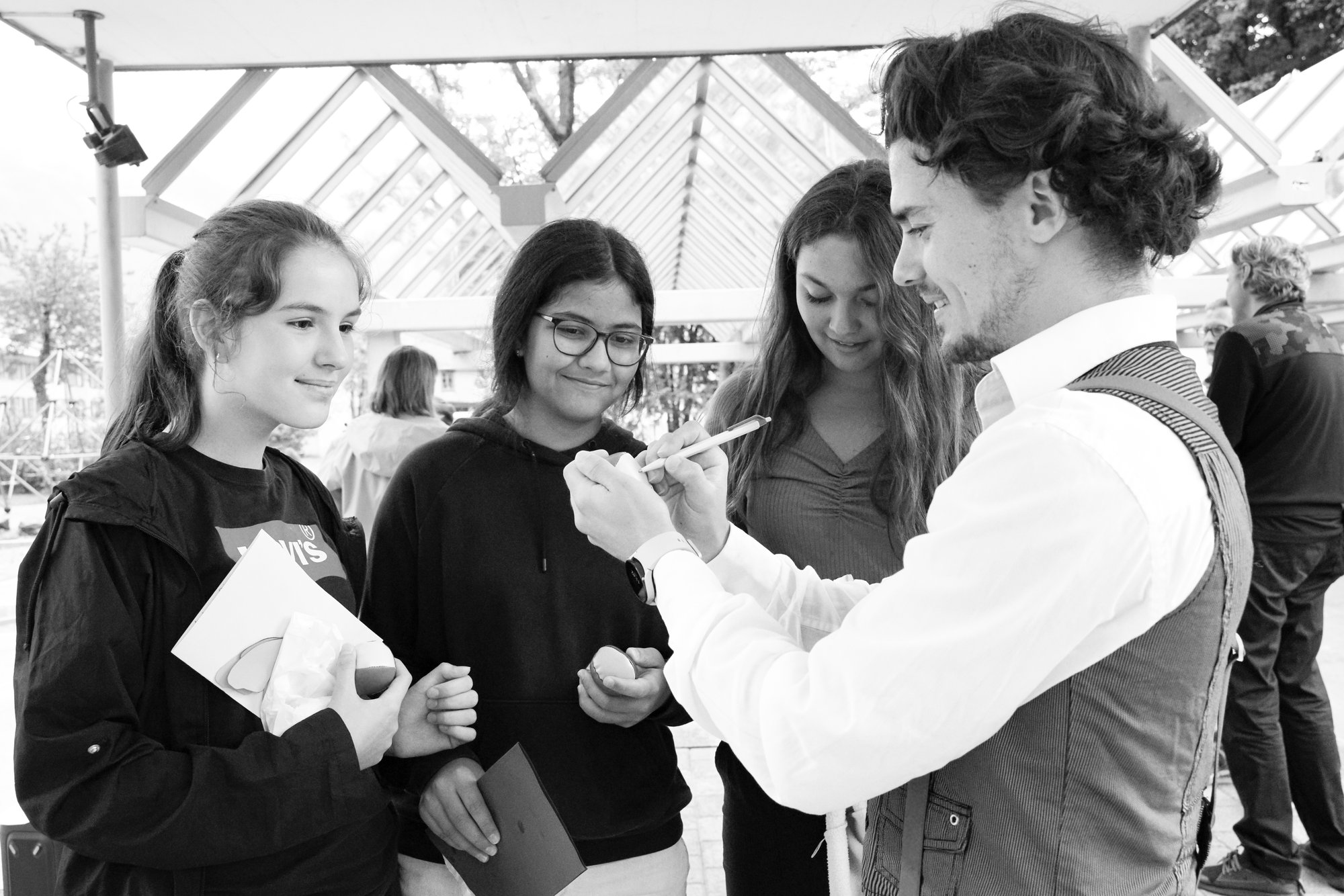
I've been teaching circus since I was sixteen. Every group hears my core sentence: you can do anything you want — but it must be intentional, and you must be able to do it again. The first part is for creativity: there is no right or wrong. The second is against happy accidents: in juggling, wonderful things happen by coincidence, but you have to know why you wanted them. The third is the craft: a trick shot caught once in four hours of camera time works on TikTok — it doesn't work on stage. Performing means taking your silliness seriously.
The discipline matters far less than the experience. A child who feels seen and capable in a circus tent carries that feeling into their maths class, their friendships, their sense of self. Circus is uniquely good at this because it has no single right answer — there are a hundred ways to balance, to throw, to fall, and every child can find their own.
The deepest lesson came during my civilian service, working with Ukrainian refugee children. The school system saw kids who wouldn't sit still; I saw kids who had just fled a war and didn't understand the language — nothing about their behaviour was unnatural. We could barely speak to each other, but I know body language, and I always had my juggling balls. Inside the play, all the real conversations happened without words. One ten-year-old taught me more about pressure than any adult ever has: translating for his mother, navigating asylum bureaucracy at an age where I'd been climbing trees, trying so hard to be good that no room was left for being a child. Once I understood what he was carrying, my frustration evaporated — and never really came back, for any child. Since then I try to be an anchor without creating dependence: to make children feel heard, and let play do the heavy lifting.
I co-own Zirkus Zirkusa with Colette Orler, bringing circus project weeks to schools and holiday camps. I'm Artistic Director of two-week sessions at Young Stage Circus Camps in Basel — a team of eight coaches and around ninety children. I've led camps at Zirkus Mugg since 2010, taught weekly classes at Bühnerei Winterthur for ages 7 to 50, coached school projects for Circus Luna, and taught freerunning in Dutch in Tilburg. I'm a World Juggling Federation Certified Instructor and hold advanced childcare certifications (BKI1, BKI2, KoBe) from the Swiss Federal Office for Civilian Service.
Kompani Giraff (Viktoria Dalborg) brought me into Moln and Giraffens ABC — two shows that taught me how circus can speak to children without ever talking down to them. KNOT Kollektiv gave me Internal Jogging, a piece about community with the audience inside it. With Alienated Performance Art (Kelly Vanneste) I made Playstation Blackout, a raw, high-energy duet born from two referee chairs in a bar. And Critical Mess gave me six years inside Stefan Sing's organic juggling — first Dodai, then Superorganism.
Three questions drive the next years. Can the balls know exactly where they are — centimeter-precise — so that the room itself becomes an instrument, with different music living in different corners of the stage? What happens when it's not two of us but six — a juggling orchestra, or as I prefer to put it, a juggling boy band? And can what we teach children be the frontier of the art form at the same time as it is simply circus pedagogy? At Zirkusa, we intend to find out.
July 2026 — Amble Fusion: Mersenne premiere (solo).
May 2026 — Amble Fusion: Echoes premiere (duo).
2025–Present — Co-owner, Zirkus Zirkusa (with Colette Orler). Circus project weeks for schools and holiday camps, Näfels, Glarus.
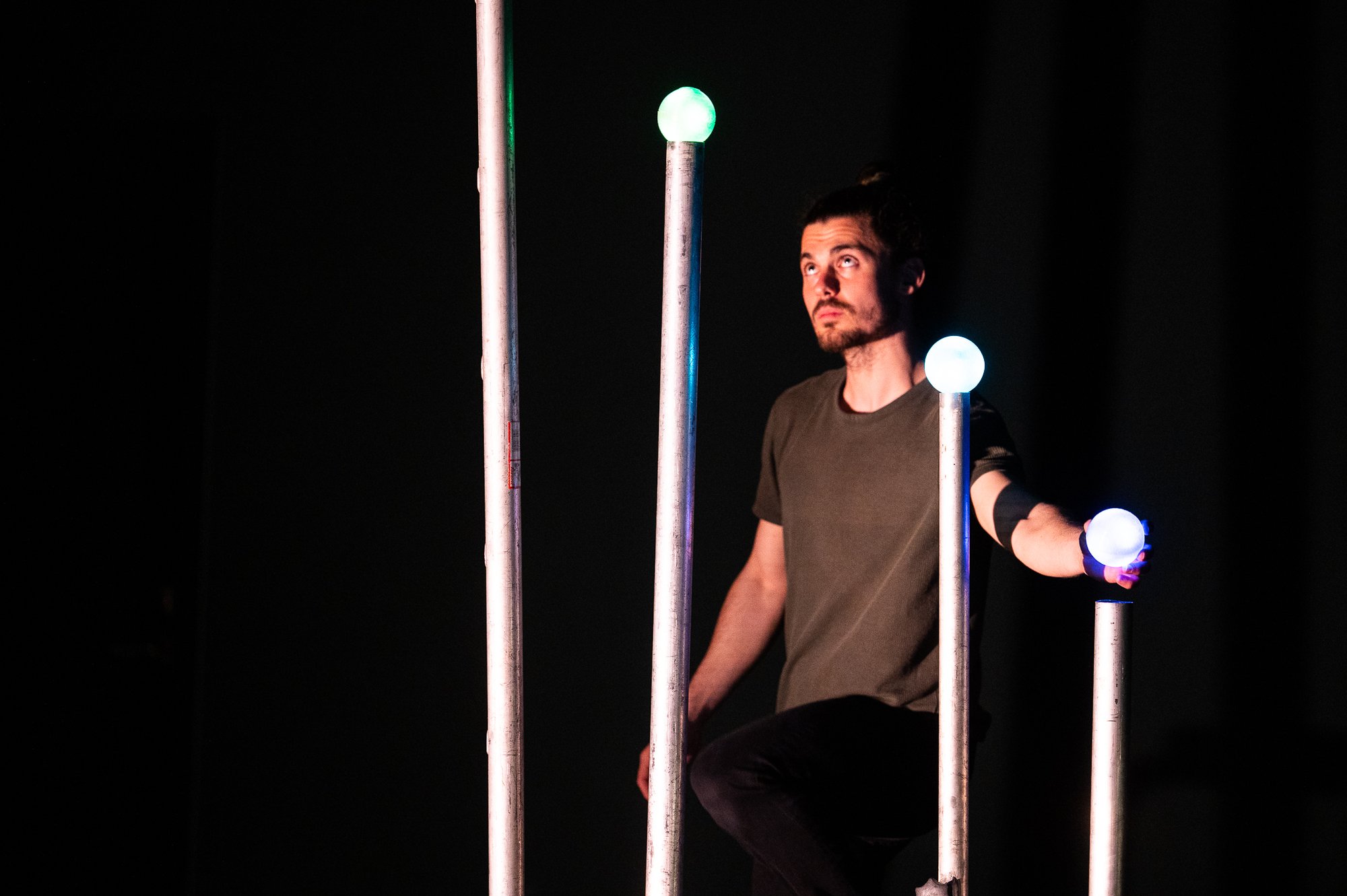
2024–Present — Amble Fusion. Solo show with sensor-equipped juggling balls. Residencies at Maison des Jonglages (Paris), Dynamo (Odense), La Grille, Aula der Kantonsschule Glarus, Br'Ain du Cirque (Bourg-en-Bresse). Also performing in Giraffens ABC, Kompani Giraff.
2023 — Brain Games, guest performer with Bruno Spoerri & Gabriel Schiltknecht, Forum für Musik Glarus.
2023–2024 — Superorganism, Critical-Mess (dir. Stefan Sing). Performances at European Juggling Convention (Lublin), Tête-à-Tête (Rastatt), Atoll Festival (Karlsruhe).
2021–2023 — Moln, Kompani Giraff. Replaced Benjamin Beaujard. Performed at CirkusMania (Stockholm), Malmö Live, and on tour.
2019–2023 — Internal Jogging, KNOT Kollektiv. Interactive dance/circus performance. Premiered at Chassé Theater, Breda. Also performed at Sommerwerft Festival, Frankfurt.
2019 — Contemporary Juggling meets Alpine Sounds, with Roland & Gabriel Schiltknecht, Güeterschuppen/Gepäckausgabe Glarus.
2018–2023 — Dodai, Critical-Mess (dir. Stefan Sing). Premiered at Flottmann-Hallen, Herne. Performed at Tanzbiennale Heidelberg, Circusstad Festival Rotterdam, and on tour.
2018–2021 — Playstation Blackout, Alienated Performance Art (Kelly Vanneste). Performed at Delft Fringe Festival, Theaterfestival Boulevard ('s-Hertogenbosch).
2017–today — Amble Fusion (development).
2015–2019 — Bachelor of Arts, ACAPA (Fontys Hogeschool), Tilburg, Netherlands.